


Google Cardboard - How does the flat-pack stack up?


 It seems that many tech companies, including the giants, are looking to integrate users into a fully immersive virtual reality (VR) experience as soon as possible. With projects ranging from the (initially) Kickstarter-funded Oculus Rift right through to Sony’s Project Morpheus it would seem that we are about to enter into an era of strap-your-face-in-and-go immersion into alternate realities.
First things first
 A bit of context is never a bad thing. A ‘VR Headset’ refers to a head-mounted device that presents a virtual display to a user. The headset typically prevents a user from seeing anything around them other than the screen or the projected image in front of their eyes. For a long time, the issues with these headsets outweighed their commercial viability. Not least of these was motion sickness. Recent developments have ironed out (for the most part) a lot of these bugs and so the VR marketplace is rising steadily.
Google Cardboard
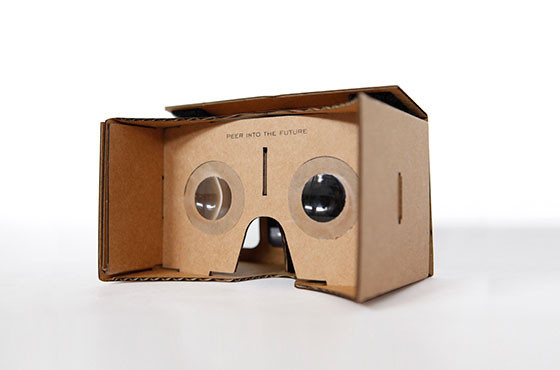
 At Google, they have taken the already existing idea of a VR headset and simplified it in a pretty unexpected way. Instead of having a relatively bulky piece of kit strapped to a user’s head, they designed a headset made of cardboard. Other manufacturers then built it and are now the ones who supply it to customers. Google Cardboard is lightweight and very easy to assemble. Instead of a built in display, a user inserts their phone and (using an app) the phone’s screen acts as the VR display. It’s important to note that although this is a Google concept, it is not limited to Android phones - iOS users can tap into this too.
 Many people see the opportunities provided by the VR industry as media-centric. By this I mean that it is viewed as a way to augment the level of interactivity offered by a media product. This could be through a videogame; a first-person view of a landscape, an interactive tour - the possibilities and applications go on and on. I’d like to propose something though; out of the VR products available on the market so far, Google Cardboard seems the likely candidate to shine in the immediate future. Here’s a few reasons why:
Accessibility
 With other VR headsets generally being above the £100 mark and going up to exorbitant amounts. The fact that you can get a pre-built Google Cardboard headset for £6 and above places it in a far different market to those with the VR tech already integrated.
Granted, Google Cardboard does not come with the VR functionality built-in, it relies on the user owning (or having access to) a smartphone. Is this a problem? Well here’s a fact: 62% of UK adults now own a smartphone (Ofcom 2014). This means that there is a massive audience ready to use Google Cardboard.
Apportunity
 Even at this relatively early stage, various apps are popping into existence across both Google Play and Apple Store.. The functionality of these apps ranges from offering a tour around the world, to taking you into a game of 3D Pong. One app even plonks you right in the middle of a load of dinosaurs (if only that was around when I was eight years old). These apps all demonstrate how Google Cardboard can be used in various scenarios. Imagine this; a travel agent could take a customer on a tour through a selection of resorts and hotels, even take them on a walk down to the nearest beach, all from the comfort of their office. Pictures of an experience are one thing, being immersed in a virtual world is altogether a different undertaking.
We doubt that Google Cardboard will be the end of Google’s foray into virtual reality, it’s likely more of a toe in the water, the big splash is yet to come. In the meantime they have a market-ready creation that is piquing the interest of brands and businesses worldwide.
Our Experiences
 We’ve been using augmented reality solutions to improve our clients’ products for longer than you’d expect.. Back in 2010 we developed WorkSnug, an application that combined multiple aspects of augmented reality to allow users to research exactly where they could set up their laptop/tablet and get some work done; this was aimed directly at coffee shops, bars and other establishments that offered free wifi across 13 (and counting) cities. Full details of the project can be found here: WorkSnug putitout.
Our experience in working with complex 3d models and blurring the lines between reality and digital offers us a unique heritage for delivering Cardboard apps.
We see Google Cardboard as an excellent way to supplement digital products and projects. Want to know how it applies to your business? Easy. Just get in touch!
17th April 2015
Posted by Charlie

FOLLOW US


